Islamic Finance Perpetuates Riba Because Ethics Cannot Intervene
Islamic finance is not failing because it lacks innovation. It is failing because it scaled without ethical architecture. Systems were built for speed, for yield, for growth — and the moment scale outranks the ability to say no, extraction finds a way in.
Riba persists in Islamic finance not because scholars misunderstand it, but because they are asked to legitimise systems they have no power to restrain.
This is the structural truth. Scholars are not failing. The institutions are. They are designed so that even the most principled oversight becomes cosmetic.
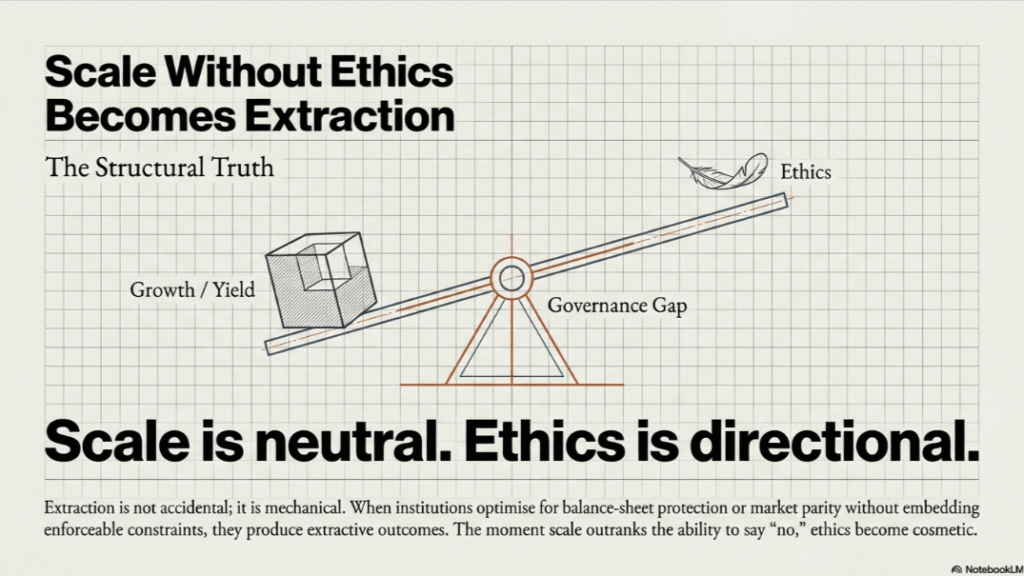
Scale Without Ethics Becomes Extraction
Scale is neutral. Ethics is directional. When institutions optimise for growth, yield, balance-sheet protection, or market parity without embedding enforceable ethical constraints, they will always produce extractive outcomes. Extraction is not accidental. It is mechanical.
Islamic finance today produces instruments, Sukuk variants, synthetic returns, and liquidity solutions. On the surface, they appear compliant. But in practice, they allow risk-free returns for capital at the expense of the real economy. Risk is shifted, obligations are insulated, incentives misaligned — and riba, in substance if not in form, survives.
This is not a matter of error, ignorance, or negligence. It is the inevitable outcome of systems built to scale faster than ethics can govern them.
Riba Is a Governance Problem, Not a Scholarly Problem
Riba is often treated as a contractual problem: interest rates, guarantees, wording. But the real problem is structural. Systems that cannot tolerate genuine loss, that shield capital from real risk, and that prioritise efficiency over ethics will always reconstruct riba, no matter how many scholars approve the language.
Scholars provide legitimacy. They offer fatwas and guidance. But when legitimacy is the last step — after structures are designed, yield engineered, and incentives misaligned — scholars can only react. Their oversight is cosmetic.
If Islamic finance truly wants to be ethical at scale, it must address governance first. Scholars cannot govern capital by themselves. Scale must be designed to respect refusal as much as it respects execution.
Why New Products Won’t Fix It
Islamic finance continues to produce new instruments, wrappers, and structures — each more complex than the last — but all remain on the same axis as conventional finance. Efficiency, liquidity, yield, and speed are optimised. Ethics are optional.
No additional products can correct a system where speed outranks refusal. No instrument can prevent extraction if the institutional architecture incentivises it. Innovation without governance is not reform. It is camouflage.
The Fintech Trap
The same logic applies to Islamic fintech startups. They are often framed as solutions: leaner, more modern, digitally native, and capable of scaling quickly.
Yet, the majority replicate the same structural flaw:
- Rapid scale without systemic veto power
- Products designed for market adoption rather than ethical integrity
- Reliance on cosmetic Shariah approvals after the fact
A fintech platform may look innovative. It may attract younger investors or tech-savvy users. But if its design does not resist riba structurally, it is just a modern version of the same problem. New technology amplifies speed and reach, but without embedded ethical governance, it amplifies extraction, too.
What Real Reform Requires
Systemic reform requires people willing to sit above deal-making. They must be able to veto profitable deals, walk away when principles are breached, and govern scale before it governs them.
Reformers will not optimise for conferences, public accolades, or optics. They will prioritise substance over visibility. They will accept slower growth, lower yield, and smaller market share — because principles are not negotiable.
These are not incremental thinkers. They are architects of restraint. They do not merely interpret the rules; they enforce them. They create systems where riba cannot survive structurally, not just contractually.
The Orthogonal Shift
Islamic finance does not need to compete harder on the conventional axis. It must step off it entirely. Only an orthogonal approach can ensure capital flows without extraction, risk is fairly distributed, and ethics are embedded in the architecture itself.
This is deliberate, difficult, and often unpopular. But it is the only way to deliver real, scalable, and genuine impact. Anything else is delay, dressed as progress.
Closing
The future of Islamic finance will not be built by better marketing, new products, or cosmetic fatwas.
It will be built by those who govern capital before it scales, who enforce refusal when necessary, and who accept that ethical architecture is heavier, slower, and harder — but essential