Religious Prohibitions and the Role of Friction: Adaptive vs Resilient Systems

Introduction
Religious systems throughout history have imposed prohibitions upon their followers. These prohibitions may concern food, sexuality, labour, ritual conduct, consumption, or social interaction. While such restrictions are often examined in theological or moral terms, they may also be analysed structurally as forms of friction placed between human desire and permitted action. The existence of this friction raises an important question: how does a religious system respond when its prohibitions create difficulty for believers?
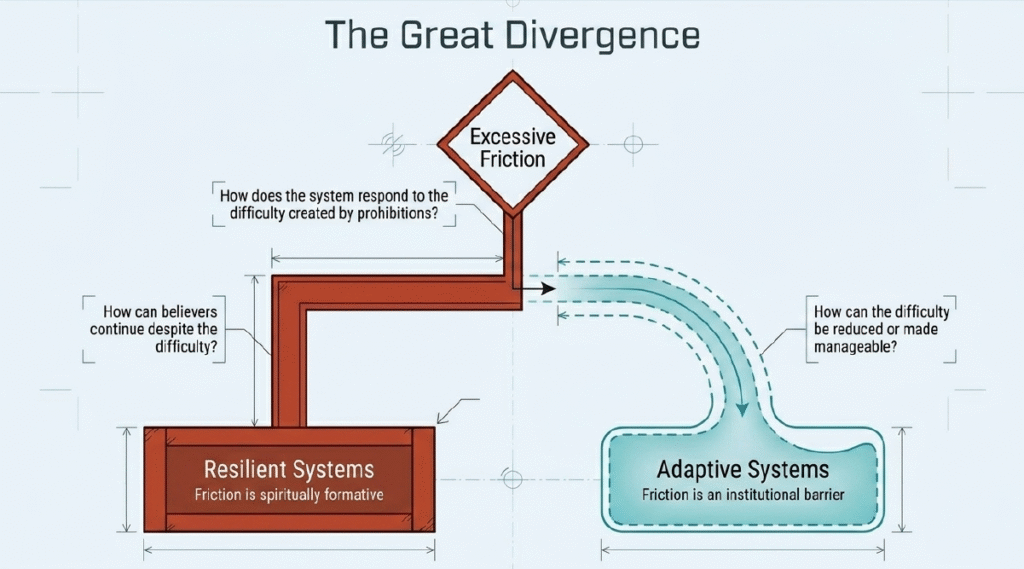
Two broad responses commonly emerge. One approach treats friction as spiritually meaningful and seeks ways to continue functioning within the constraint. The other treats excessive friction as a problem to be reduced, reinterpreted, or avoided in order to maintain accessibility and social integration. These two responses can be described respectively as resilient and adaptive religious systems.
This paper argues that religious systems are shaped not only by the content of their prohibitions, but by their interpretation of friction itself. Systems that embrace friction often develop resilience, cohesion, and durable identity, while systems that minimize friction often develop adaptability, accessibility, and social flexibility. Both approaches possess strengths and weaknesses, and both represent recurring patterns throughout religious history.
Defining Friction in Religious Systems
Religious prohibitions operate by restricting actions that individuals might otherwise pursue freely. These restrictions can involve dietary laws, fasting obligations, rules governing sexuality, mandatory rituals, or limitations upon wealth and consumption. In each case, the prohibition introduces friction between personal inclination and accepted conduct.
This friction may take several forms. It can be physical, as in fasting or pilgrimage; psychological, as in resisting temptation; social, as in refusing behaviours accepted by wider society; or economic, as in restrictions upon work, trade, or luxury. Importantly, religious traditions do not always view this friction as accidental or unfortunate. In many cases, the difficulty itself is considered spiritually valuable.

The distinction between resilient and adaptive systems emerges from how this friction is interpreted. A resilient system asks: “How can believers continue despite the difficulty created by the prohibition?” An adaptive system instead asks: “How can the difficulty itself be reduced or made more manageable?” The first approach treats friction as formative, while the second treats excessive friction as a barrier to sustainable participation.
These differing assumptions profoundly shape religious institutions, communal identity, and long-term survival. The issue is therefore not simply whether prohibitions exist, but whether friction is regarded as spiritually necessary or institutionally problematic.
Resilient Religious Systems
Resilient religious systems interpret friction as an essential part of spiritual life. In such systems, prohibitions are not merely rules to obey but mechanisms through which discipline, endurance, and transformation are produced. Difficulty becomes morally and spiritually productive rather than purely restrictive.
Many historical religious traditions demonstrate this orientation. Monastic Christianity, for example, developed highly structured forms of fasting, celibacy, silence, and labor intended to cultivate self-control and detachment from worldly desire. The Benedictine Order established strict daily routines in which discipline itself became central to religious formation. Similarly, the fasting obligations of Ramadan require believers to maintain religious duties despite bodily discomfort and disruption to ordinary habits. Orthodox Jewish dietary laws also create continuous friction between religious observance and convenience, particularly in secular environments.
Within resilient systems, prohibitions function as identity-maintaining structures. The willingness to endure inconvenience demonstrates commitment to the community and reinforces distinction from surrounding society. Friction therefore strengthens group boundaries. Practices that are costly or difficult often become especially important because they separate committed participants from casual affiliation.
Such systems possess several advantages. They frequently develop strong communal cohesion, high levels of commitment, and substantial long-term durability. Because members are accustomed to operating under constraints, resilient systems may also survive external pressure more effectively than highly adaptive systems. Minority religious communities, in particular, often preserve identity through disciplined resistance to assimilation.
However, resilient systems also possess weaknesses. Excessive emphasis upon discipline can create rigidity, guilt culture, social exclusion, or resistance to necessary reform. Friction may become so severe that participation declines or hypocrisy increases. In extreme cases, the preservation of the system itself can become more important than the well-being of its participants.
Nevertheless, resilient systems persist throughout history because they transform friction into meaning. The obstacle is not treated as evidence of failure but as part of the religious process itself.
Adaptive Religious Systems
Adaptive religious systems approach prohibitions differently. Rather than emphasizing endurance within friction, they seek ways to reduce, reinterpret, or soften the burdens created by religious constraints. The primary concern becomes maintaining sustainable participation while allowing integration with changing social conditions.
In adaptive systems, prohibitions are often contextualized historically or symbolically. Rules may remain formally present while their practical enforcement weakens. Greater emphasis may be placed upon personal intention rather than strict observance. In some modern religious movements, prohibitions that once structured daily life become treated as individual choices or cultural traditions rather than binding obligations.
This orientation is especially common within religious communities operating in highly secularized or pluralistic societies. Liberal Protestant movements, for example, frequently reinterpret traditional restrictions in light of modern social values, scientific knowledge, or contemporary ethical concerns. Similar patterns appear in reform movements across multiple religions where institutional survival depends upon reducing barriers to participation.
Adaptive systems possess important strengths. They often integrate more successfully into rapidly changing societies and may attract broader participation by lowering the social and psychological costs of membership. Flexibility also allows these systems to respond more effectively to new technologies, political structures, and cultural expectations.
Yet adaptation introduces its own risks. As friction decreases, communal boundaries may weaken. Religious identity can become increasingly symbolic rather than behavioural, reducing the distinctiveness that once maintained cohesion. Over time, excessive adaptation may produce systems that struggle to justify the continued existence of their prohibitions altogether. If religious participation demands little sacrifice, commitment itself may gradually lose intensity.
Adaptive systems therefore preserve relevance through flexibility, but they may weaken the durable identity that resilient systems maintain through disciplined resistance.
Comparative Analysis: Adaptation and Resilience
The distinction between adaptive and resilient religious systems reflects two different understandings of the role of friction in human life. Resilient systems assume that difficulty forms character, strengthens commitment, and preserves communal identity. Adaptive systems assume that excessive difficulty discourages participation and prevents sustainable integration with society.
Neither approach is universally superior. Different historical conditions favor different responses. Religious minorities living under external pressure often rely upon resilient structures to survive assimilation. Strong prohibitions and disciplined practices help preserve identity across generations. By contrast, religions embedded within rapidly modernizing societies may adopt adaptive strategies in order to maintain relevance and participation.
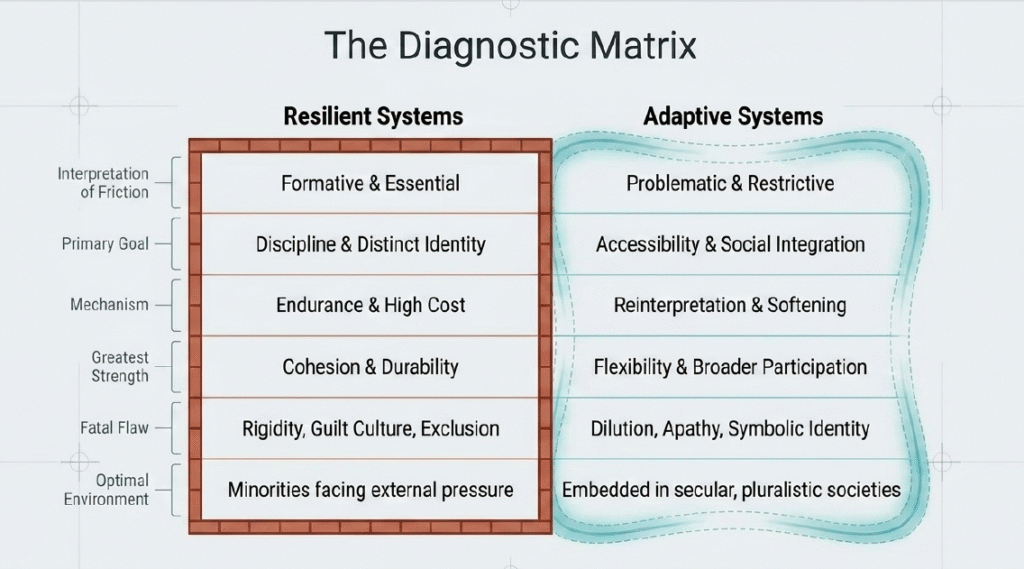
The long-term weaknesses of each system mirror the strengths of the other. Resilient systems risk becoming rigid and isolated, while adaptive systems risk becoming diluted and unstable. Excessive friction can drive individuals away from religious participation, yet the near elimination of friction can weaken the meaningful distinctiveness that sustains communal commitment.
In practice, many successful religious traditions contain elements of both approaches. Certain core prohibitions remain highly resilient and non-negotiable, while secondary practices become more adaptive over time. This balance allows systems to preserve identity without becoming entirely inflexible.
The central issue, therefore, is not whether prohibitions exist, but how a community interprets the friction they create. Friction may be viewed either as a mechanism of transformation or as an obstacle requiring accommodation. The answer to that question significantly shapes the structure and survival of religious systems.
Conclusion
Religious prohibitions create friction by placing constraints upon human behaviour, desire, and social participation. The manner in which religious systems respond to this friction produces two broad structural orientations: resilient systems that embrace difficulty as spiritually formative, and adaptive systems that seek to reduce or reinterpret difficulty in order to maintain accessibility and relevance.
Resilient systems often develop strong identity, cohesion, and long-term durability through disciplined resistance to external pressures. Adaptive systems often develop flexibility, inclusivity, and social integration through accommodation to changing conditions. Both approaches possess significant advantages as well as important vulnerabilities.
Ultimately, the enduring character of a religious system may depend less upon the specific content of its prohibitions than upon its understanding of friction itself. Whether friction is regarded as essential to transformation or as a barrier to participation fundamentally shapes the development, stability, and future survival of religious communities.