Introduction
Refusal to collapse time is the principle modern Islamic finance has abandoned — and it explains why the system is failing. By compressing the future into guaranteed returns and engineered certainty, contemporary structures mimic conventional finance while calling themselves halal. The prohibition of riba was never about paperwork or contracts; it was a refusal to seize the future before it exists. Ignoring this moral horizon turns compliance into a façade, risk-sharing into risk displacement, and transforms the spirit of Islamic finance into a hollow imitation of what it was meant to be.
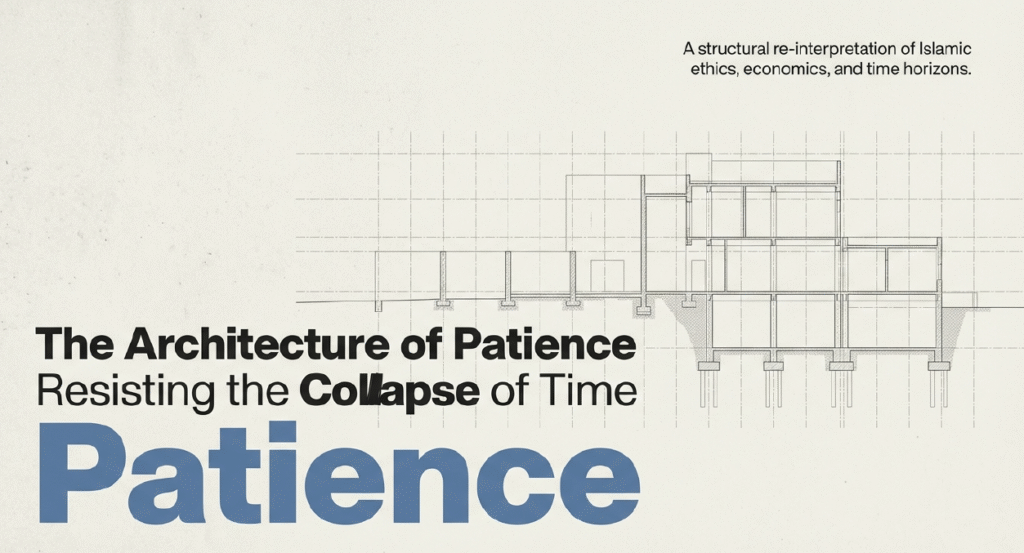
Refusal to Collapse Time
Islam is not hostile to the world.
It is hostile to immediacy.
At the heart of the faith is a refusal to treat the present moment as the final court of meaning. Accountability is delayed. Justice is incomplete in this world. Outcomes are not fully legible at the point of action.
This is not incidental theology. It is structural.
Islam insists that actions be judged across time — including consequences that unfold slowly, invisibly, or beyond one’s lifetime. Meaning is not captured immediately; it is revealed.
This posture can be named plainly: refusal to collapse time.
The phrase does not introduce a new ethic. It describes what Islam has always assumed.
When time is collapsed, urgency becomes authority. What works now overrides what endures. Ethics is shortened until it fits inside convenience.
Islam resists this shortening at every level.
- Prayer interrupts productivity instead of optimising it.
Fasting delays gratification instead of managing intake.
Zakat redistributes value without guaranteed return.
Sabr governs restraint when outcomes are uncertain.
These practices make little sense under compressed time. Their purpose is not efficiency, but formation — training the believer to act without immediate validation and to trust that truth emerges through endurance, not speed.
Nowhere is this clearer than in the prohibition of riba.
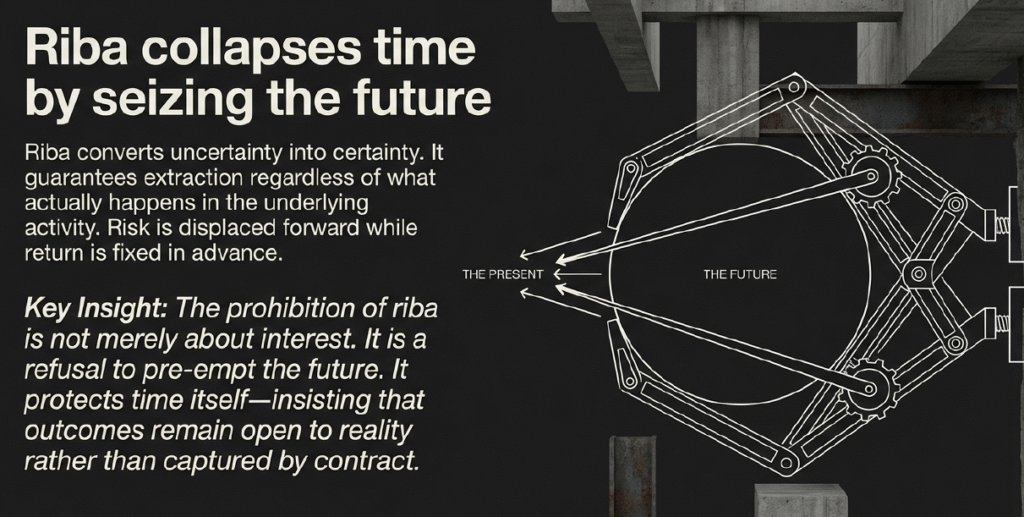
Riba collapses time by seizing the future. It converts uncertainty into certainty, guaranteeing extraction regardless of what actually happens in the underlying activity. Risk is displaced forward while return is fixed in advance.
What looks like stability in the short term is revealed, over time, as asymmetry: one party accumulates while another absorbs volatility, delay, and failure.
The prohibition of riba is therefore not merely about interest. It is a refusal to pre-empt the future. It protects time itself — insisting that outcomes remain open to reality rather than captured by contract.
Modern approaches often fail not because they misunderstand the rules, but because they refuse the cost of waiting. They preserve compliant forms while reinstating time collapse through engineered certainty, displaced risk, and shortened evaluation windows.
The problem is not sophistication.
It is impatience.
At the individual level, this same dynamic appears more painfully.
Many people do not engage riba because they deny its prohibition. They engage it because modern life enforces time compression. Housing must be secured immediately. Income must be stabilised early. Delay is punished socially and economically.
Islamic ethics distinguishes between being constrained by such structures and legitimising them.
Refusal here does not always mean instant exit. It often appears as direction rather than purity: not expanding exposure, not defending it as neutral, not normalising what is endured under pressure.
The line is not between those who are untouched and those who are compromised.
It is between those who accept time collapse as necessary and those who resist it where they can.
The same logic scales outward.
Impact in financial products and systems
In finance, collapsing time turns extraction into “return.” Short horizons hide fragility and long-term harm. What looks like performance early reveals itself as depletion later.
In technology, collapsing time turns speed into “innovation.” Shipping replaces judgment. Adoption replaces consequence. Costs are deferred beyond the evaluation window.
In institutions, collapsing time turns compliance into “ethics.” If the rule was followed, the action is deemed moral — regardless of accumulated harm. Responsibility is outsourced to process.
Across domains, the inversion is consistent.
Extraction becomes return.
Speed becomes innovation.
Procedure becomes ethics.
Necessity becomes justification.
Refusal to collapse time restores proper categories by allowing consequences to surface.
This refusal does not stifle creativity, growth, or success. It rejects their shortened definitions.
It demands creativity that survives scale.
Innovation that remains defensible after adoption.
Success that still makes sense when early advantages disappear.
Systems built on compressed time grow fast and decay faster. Systems built on extended horizons appear late and endure.
This is why refusal is often misread as obstruction. It resists the dominant metric of modern life: immediacy.
But refusal here is not passivity.
It is discipline.
It is the discipline of letting time reveal what urgency tries to conceal.
And that discipline is not a retreat from the world.
It is how faith remains intact within it.